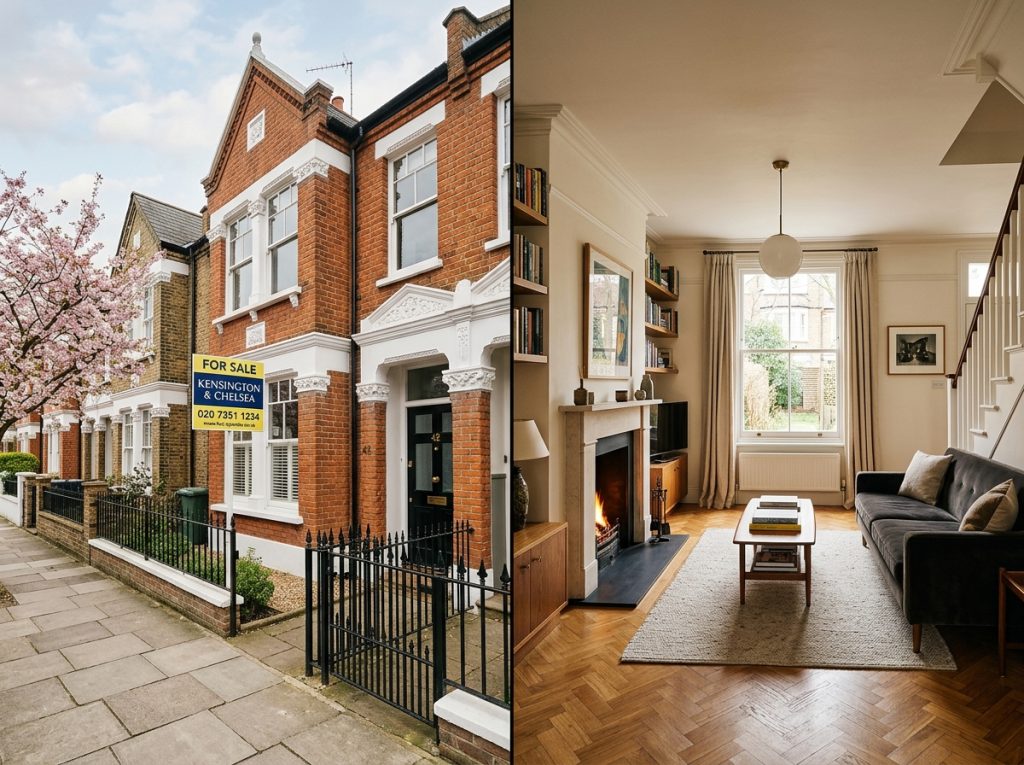
At some point, most homeowners who’ve outgrown their property ask the same question: is it better to renovate what we have, or sell up and buy something bigger? It’s tempting to compare a renovation quote directly against a new property’s asking price, but that comparison misses most of what actually gets spent on a move — and in London specifically, those hidden costs are large enough to change the answer.
What Moving Actually Costs, Beyond the Purchase Price
The purchase price of a new property is only part of the real cost of moving. On top of it, a typical move involves:
- Stamp Duty Land Tax (SDLT) — since the nil-rate threshold for home movers reverted from £250,000 back to £125,000 in April 2025, most London buyers now pay stamp duty on a significantly larger portion of the purchase price than they would have two years ago. On a £750,000 purchase, for example, stamp duty alone runs to roughly £27,500.
- Estate agent fees if selling — typically around 1 to 1.5% of the sale price
- Solicitor and conveyancing fees — usually £1,000-£2,000 plus disbursements, on both the sale and the purchase
- Survey costs — from a few hundred pounds for a basic survey to £1,000+ for a full structural survey, again on both sides of the transaction
- Removal costs — commonly £500-£1,500 depending on property size and distance
- Mortgage arrangement fees, Land Registry fees, and the inevitable post-move spending on furnishing, redecorating, or fixing issues that only become apparent once you’ve moved in
Added together, moving costs on a typical London property purchase commonly run into the tens of thousands of pounds — money that produces no lasting asset value, unlike the equivalent spent on a renovation.
What Renovating Actually Achieves, Cost for Cost
Every pound spent on stamp duty, agent fees, or conveyancing disappears the moment the transaction completes. Every pound spent on a well-executed renovation, by contrast, becomes part of the property itself — and in many cases, adds to its resale value on top of solving the immediate space or layout problem.
This is the core of the renovate-vs-move calculation: it’s not simply “renovation cost versus house price difference,” it’s “renovation cost versus house price difference plus the full transaction cost of moving, minus whatever value the renovation itself adds back to your current property.”
When Renovating Is Usually the Better Financial Decision
- You have meaningful equity in your current property. Remortgaging or taking a further advance to fund a renovation is often more affordable than taking on a larger mortgage to fund the price difference of a bigger property, since you’re avoiding the transaction costs on both ends entirely.
- Your current location is hard to replace. If proximity to schools, work, family, or simply an established neighbourhood you don’t want to leave is a genuine priority, moving to get more space usually means compromising on location — a trade-off a renovation avoids entirely.
- The property has genuine untapped potential. A loft that could become a bedroom, a garden with room for a rear extension, or a layout that could be reconfigured for significantly more usable space all represent value that can be unlocked without a move.
- The property market is slow or uncertain. In a slower sales market, selling takes longer, chains are more fragile, and you may not achieve the price you’d hoped for — renovating removes that uncertainty from the equation entirely.
When Moving Might Still Make More Sense
- The fundamental problem is location, not space. No renovation fixes being in the wrong catchment area, too far from work, or in a neighbourhood that no longer suits your life.
- The property has structural limitations a renovation can’t reasonably solve. A plot too small to extend, a freeholder or lease that restricts significant alteration, or a listed building with genuine constraints on what can be changed can all mean a renovation simply can’t deliver what’s needed.
- You’d need to borrow considerably more to renovate than the resulting value uplift would justify. If a realistic renovation budget would leave you “over-improved” relative to what similar properties in the area actually sell for, that ceiling is worth understanding before committing to a large renovation spend.
A Practical Way to Run the Comparison
- Get a genuine, itemised renovation quote for the scope that would solve your actual space or layout problem — not a rough estimate, but something detailed enough to compare meaningfully.
- Calculate the full cost of moving, not just the price difference between properties — include stamp duty at current rates, agent fees if selling, conveyancing on both sides, surveys, removals, and a realistic allowance for post-move spending.
- Get a rough estimate of the value a renovation would add to your current property from a local estate agent or surveyor — this isn’t guaranteed, but it gives you a realistic range rather than treating renovation spend as pure cost.
- Compare the two totals side by side, including how each option affects your mortgage or borrowing position, not just the headline numbers.
- Weigh the non-financial factors honestly — the disruption of a renovation versus the disruption and uncertainty of a sale and purchase, and how much weight your current location genuinely carries in the decision.
A Note on Timing
Stamp duty rates and thresholds are set by government policy and have changed multiple times in recent years — the current position, with the nil-rate threshold back at £125,000 for home movers, is meaningfully less favourable than it was during the temporarily raised threshold that applied until April 2025. This is worth factoring into the comparison as a current, rather than fixed, cost — it’s realistic to assume further changes are possible over time, but decisions should be made against today’s actual rates, not an assumption that conditions will improve.
The Comparison Is Rarely as Close as It First Appears
Once the full cost of moving is actually totalled up — not just the price difference between properties, but every transaction cost on both ends — renovating an existing property in a location that already works is very often the stronger financial decision, particularly in London where property values, and therefore stamp duty and agent fees, are higher than the national average. The exception is when the underlying problem genuinely can’t be solved by renovation — location, plot size, or a lease and planning environment that rules out the changes actually needed.
At Alborz Groups, we help clients work through this decision properly — with an honest assessment of what a renovation could realistically achieve on their specific property, compared against the full cost of moving. If you’re weighing this decision, get in touch for an initial consultation.