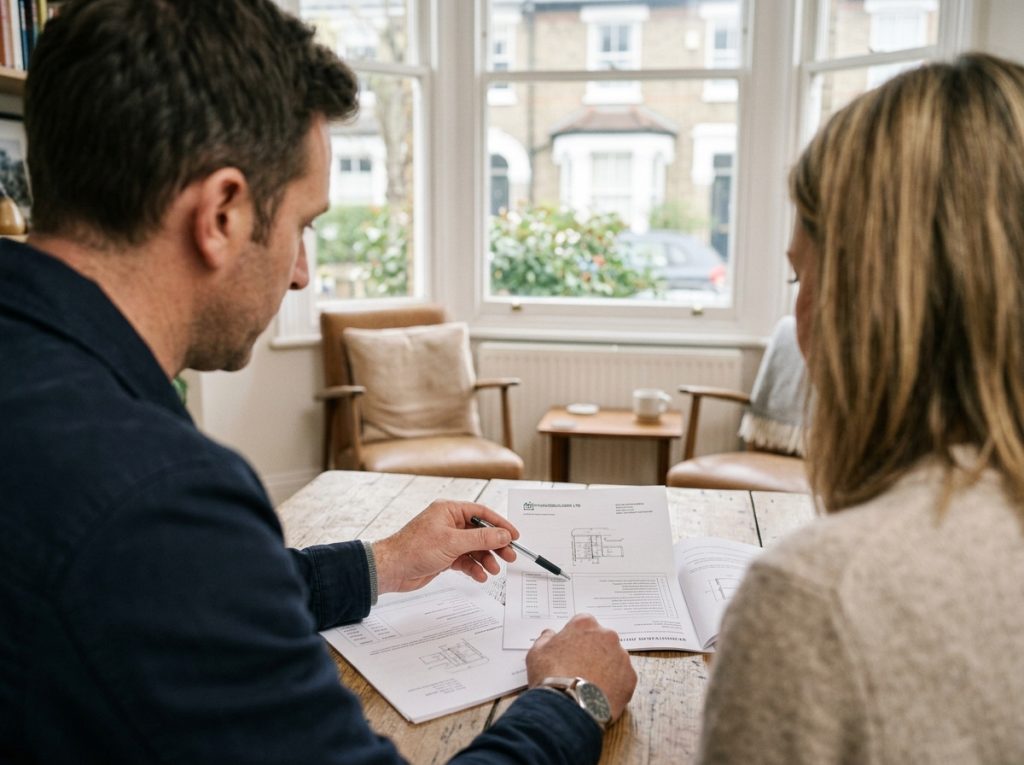
Hiring a builder means handing over your home, a large sum of money and several months of your life to someone you may have met twice. Most builders are professional and reliable. A few are not, and the problems tend to show up early if you know what to look for.
These are the checks worth making before you sign, in roughly the order to make them.
1. Verify Memberships Directly, Don’t Trust the Logos
A trade association logo on a website or van proves nothing by itself. Logos get copied. If a builder claims membership of a trade body, check it on that body’s own member-search page. The Federation of Master Builders, for example, offers a “Check a Member” service for exactly this. A builder who is a genuine member will not mind you checking.
2. Ask for Proof of Insurance
At a minimum, a builder working on your home should hold public liability insurance. Ask to see the current certificate, check the dates and check what it covers. For larger projects such as extensions, loft conversions and structural work, it is also worth asking about employer’s liability cover for any staff on site and about how the project is insured against damage to the existing building. If the answer is vague, treat it as a warning.
3. Check Specialist Registrations for Specialist Work
Some work legally requires a registered professional:
- Gas work must be carried out by someone on the Gas Safe Register
- Electrical work is typically signed off by someone registered with a competent person scheme such as NICEIC or NAPIT
Ask who will do this work and how it will be certified. A good builder will explain, and will hand you the certificates when the job is done.
4. Speak to Previous Clients
References are worth far more than a polished portfolio. When you speak to previous clients, ask about the things that actually matter:
- Did the final cost match the original quote, and if not, why?
- How clearly were extra charges explained before they were incurred?
- Was the site kept tidy and safe?
- How did the builder handle problems when they came up?
- Did the project finish on time?
- Did they come back to fix defects afterward?
If possible, ask to see completed projects in person, not only photographs.
5. Get at Least Three Detailed Written Quotes
Comparing quotes only works if each builder is quoting for the same thing. Give every builder the same drawings, specification and scope. A useful quote breaks down:
- Labour and materials
- What is included, and what is explicitly excluded
- VAT
- Provisional sums (allowances for items not yet decided)
- A realistic timeline
A single total with no breakdown makes comparison impossible and leaves room for disputes later. The lowest price is not automatically the best value: look at what sits behind each number.
6. Be Careful With Very Low Quotes
A quote far below the others deserves a question, not a celebration. It may reflect a smaller scope than you assumed, lower-quality materials, or a business pricing a job too thinly to finish properly. Ask what is excluded and how the builder expects to cover unexpected costs.
7. Insist on a Written Contract
No work should start without a written contract. It should set out:
- The scope of work and specification
- The price and how it is calculated
- The payment schedule
- The start and completion dates
- How variations (changes to the agreed scope) are agreed and priced
- How defects are handled after completion
A builder who resists putting any of this in writing is telling you something.
8. Understand Payment Schedules and Deposits
On larger projects, payments are normally staged against progress rather than paid all at once. A deposit of around 10% is common, and a retention of roughly 2.5% to 5% held back until defects are put right is also common practice. These are customary figures, not legal requirements, and they vary by project and contract, so agree them in writing.
Pay by traceable methods, avoid cash, and keep receipts. If a builder asks for a large upfront payment, ask what it is for. If their bank details change partway through, verify the change using a phone number you already trust, not one in an email.
9. Pay Attention to How They Communicate
Early behaviour predicts later behaviour. Do they return calls, answer questions clearly and turn up when they say they will? Do they explain trade-offs, or talk over your questions with jargon? Do they put pressure on you to decide quickly? A builder who rushes you before the paperwork is signed is unlikely to slow down for your concerns once the work starts.
Red Flags in One List
- Won’t give a detailed written quote or contract
- Resists showing insurance, references or registrations
- Pressures you to decide immediately
- Asks for a large upfront payment with no clear reason
- Quotes dramatically below the market without explanation
- Asks to be paid in cash
- Has no verifiable address, past projects or reviews
Questions to Ask at the First Meeting
- Can I see your insurance certificates?
- Which trade bodies are you a member of, and how can I verify that?
- Can I speak to two or three recent clients and see a finished project?
- Does your quote include VAT, waste removal and a contingency?
- How are changes to the scope priced and agreed?
- What is the payment schedule, and what is held back until completion?
- Who will be on site day to day, and who is my main contact?
The Right Builder Welcomes These Questions
Good builders are used to being checked and often prefer it, because it filters out customers who would otherwise cause disputes. If a builder is comfortable with every item on this list, that is a good sign on its own.
At Alborz Groups, we manage projects end to end, from design and planning through to final sign-off, with a written scope and clear communication at every stage. If you’re comparing firms for an upcoming project, get in touch for an initial consultation and bring this checklist with you.