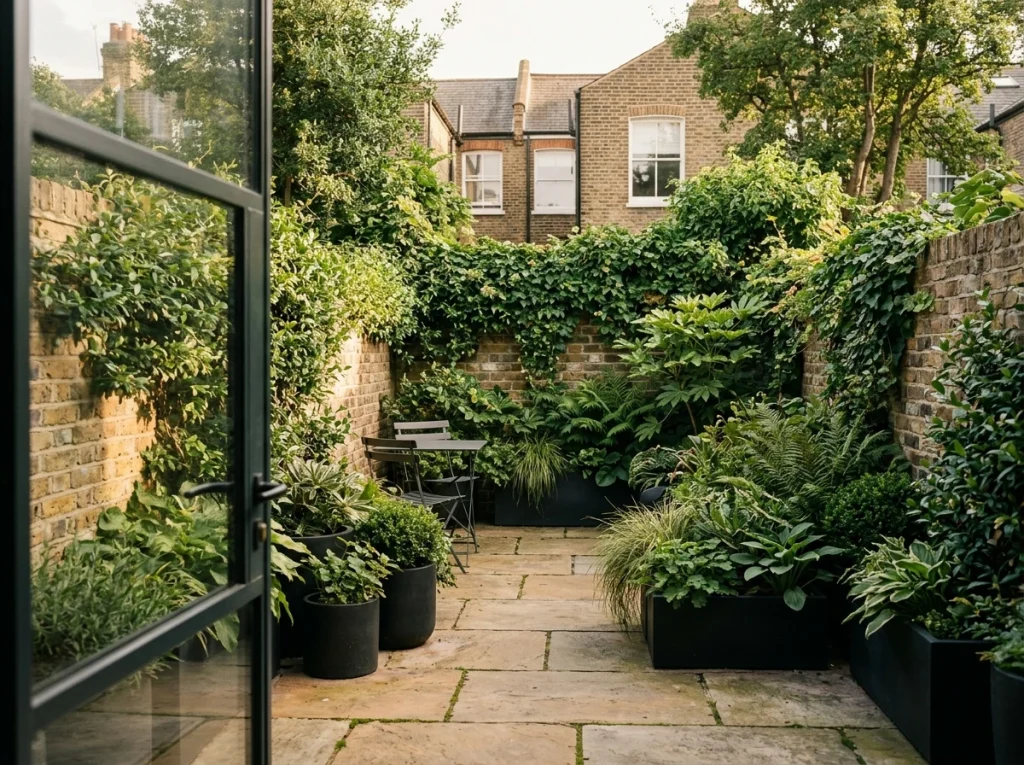
Most London gardens are small: a narrow strip behind a terrace, a courtyard off a basement flat, a shaded patch between tall neighbouring walls. They are also often the most-used outdoor space a household has. A small garden doesn’t need to be a compromise, but it does need clearer decisions than a large one, because there is nowhere for a mistake to hide.
Here are the ideas that make the biggest difference.
1. Use Walls and Fences as Growing Space
When the ground area is limited, the vertical surfaces become planting space. Evergreen climbers give structure through winter, and a few well-chosen plants can soften a hard boundary completely. Star jasmine gives year-round foliage and scented summer flowers in a sunny spot, and climbing hydrangea clings without ties and copes with a north-facing wall. Tall planters at different heights add a sense of scale, and they can draw the eye upward, away from how small the footprint is.
2. Build the Planting Around an Evergreen Spine
A garden planted only with seasonal colour looks bare for half the year, and in a small garden that is what you see from the kitchen window every day from November to March. Start with a permanent evergreen structure, such as a Viburnum tinus, then layer groundcover, bulbs and scented winter flowers around it. Add one or two ornamental grasses for movement and texture into late winter. The seasonal colour then becomes an accent on top of a garden that already looks finished.
3. Design for Your Microclimate, Not Against It
Two London gardens a street apart can behave very differently. Aspect, shade from neighbouring buildings, wall reflection and soil all change what will thrive:
- Sunny, sheltered, south-facing spaces with warm brick walls suit tender, sun-loving plants
- Shaded north-facing courtyards suit shade-tolerant evergreens such as fatsia and aucuba, along with hellebores and ferns
Rather than fighting the conditions with plants that struggle, choose plants that suit them. A garden that matches its conditions looks healthier and needs less rescuing.
4. Deal With Clay Soil and Drainage Early
Much of London sits on heavy clay, which holds water in winter and bakes hard in summer. If your soil is clay, improving it before planting makes a large difference. A common approach is to work well-rotted compost into the planting beds and add horticultural grit to open up the structure and help water move through. Good drainage should also be planned into hard landscaping: where water runs off patios and paths, and where it can soak away, matters as much as how those surfaces look.
If you are thinking of paving over a front garden, check the rules before you start. Laying a large area of non-porous surface can need planning permission in England, unless the water drains to a lawn or border or you use a permeable surface. Your council or the Planning Portal can confirm the current position for your property.
5. Make Privacy Planting Work Harder
London gardens are overlooked. Screening plants that also look good do two jobs at once. Evergreen shrubs that can be clipped to a tidy shape, such as Pittosporum tenuifolium, give dense cover without aggressive roots. On a roof terrace, where weight is limited, lightweight planters with tall grasses or clipped evergreen shapes give screening without adding structural load. Check the load limits on any roof terrace or balcony before adding heavy planters or paving.
6. Choose a Style and Commit to It
Small gardens look most resolved when one design language runs through all of the elements. Choose a direction, whether that is architectural, woodland, Mediterranean, contemporary urban or naturalistic, and carry it through the paving, boundaries, containers and planting. Blending two compatible styles can work. Mixing five usually looks like a collection of leftovers.
The hard landscaping sets the tone: the surface material, the boundary treatment and the furniture decide how the garden feels before a single plant goes in.
7. Plant Permanently, Add Colour Seasonally
Put most of your budget into permanent planting: shrubs, structural perennials and long-flowering plants. Then use seasonal colour as an accent:
- Spring bulbs in pots near the seating area give reliable colour where you will actually see it
- Long-flowering perennials that bloom for months and keep attractive seed heads into winter give value over a long period
- Autumn interest from a few well-chosen plants keeps the garden lively as the summer planting fades
8. Light It for the Evenings
A small garden is often used most after work, when it is already dark for much of the year. Low, warm lighting along a path, up a wall or at the base of a feature plant makes the garden usable and pleasant in the evening, and it makes the space look larger from indoors because the eye carries through the window into the garden.
9. Plan the Garden Before Buying a Single Plant
The most common mistake in small gardens is buying plants one at a time with no overall plan. The result is a collection of unrelated plants fighting for the same space. A better order of work is:
- Assess the site: light, aspect, soil, boundaries and how the space is used
- Settle the layout and hard landscaping
- Plan the planting as a whole
- Install the structure first, then the planting
A Quick Planning Checklist
- What is the aspect, and how much direct light does the space really get?
- What is the soil, and does the drainage need improving?
- Is there an evergreen structure for the winter months?
- Is there privacy where you need it, and is it done with plants that look good?
- Is there a single clear style running through paving, boundaries, planting and furniture?
- Is there lighting for evening use?
- If paving over a front garden, have you checked planning rules and drainage?
A Small Garden Rewards a Clear Plan
A small garden leaves little room for second guesses, which is why a clear plan matters more than the size of the budget. Done well, a compact London garden can feel generous, calm and connected to the house it belongs to.
At Alborz Groups, we design and build gardens to the same standard as the rest of the house, from hard landscaping through to planting. If you’re planning a small garden in London, get in touch for an initial consultation.