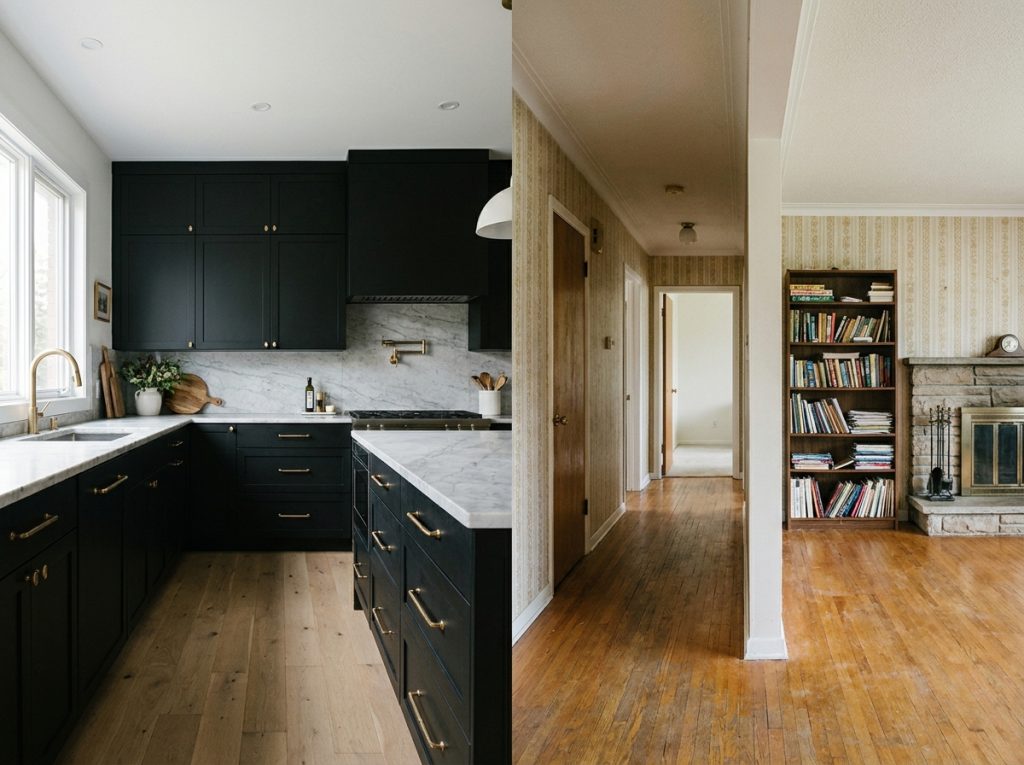
Most homeowners don’t have an unlimited budget or an open-ended timeline, which means a genuinely common question comes up early in almost every renovation conversation: should the kitchen be renovated on its own first, or does it make more sense to take on the whole property in one coordinated project?
There’s no single right answer, but there is a clear way to think through it — and getting this decision wrong is one of the more expensive mistakes homeowners make, either through unnecessary disruption (renovating twice) or through underinvestment (a beautiful kitchen surrounded by rooms that now look dated by comparison).
Why This Decision Matters More Than It First Appears
A kitchen renovation and a full home renovation aren’t just different in scale — they’re different in what they solve. A kitchen renovation solves a specific, visible problem: an outdated or poorly functioning kitchen. A full home renovation solves structural and systemic problems — ageing wiring, inadequate insulation, an inefficient layout — that a kitchen renovation alone can’t touch, even if the kitchen happens to be where those problems are most visible.
Choosing between them isn’t really “which room matters more.” It’s “which problem is actually costing us more, right now.”
The Case for Renovating the Kitchen First
When it makes sense:
- The rest of the property’s services (wiring, plumbing, heating) are in reasonable, safe working condition
- The layout of the home works — you’re not fighting the floor plan on a daily basis
- Budget is genuinely limited, and stretching it across the whole property would mean compromising quality everywhere rather than doing one room properly
- The kitchen is the room where daily frustration is highest — poor storage, an inefficient layout, or worn-out finishes that affect quality of life every day
The trade-off to accept: a beautifully renovated kitchen can make the rest of the property look more dated by comparison, simply through contrast. This isn’t a reason to avoid the renovation — it’s a reason to expect it, and potentially plan a lighter-touch refresh (paint, lighting, flooring) in adjoining rooms to reduce the visual gap.
The Case for a Full Home Renovation First
When it makes sense:
- The property has underlying issues — old wiring, no proper insulation, damp, an inefficient heating system — that will need addressing eventually regardless of which room is renovated first
- The layout doesn’t work at a structural level, and fixing the kitchen alone won’t resolve how the whole ground floor functions
- You’re planning to stay in the property long-term, which makes the disruption of a single larger project more worthwhile than the cumulative disruption of several separate ones
- You can access a mortgage, renovation loan, or savings sufficient to do the work properly in one phase, rather than in an under-resourced, drawn-out sequence
The trade-off to accept: a full renovation means living with significantly more disruption for longer, and it delays finishing any single room in order to progress on all of them simultaneously. For households without the flexibility to move out or manage extended disruption, this is a genuine cost, not just an inconvenience.
The Hidden Cost of Doing It in the Wrong Order
The most expensive mistake isn’t choosing kitchen-first or whole-house — it’s renovating the kitchen fully, then discovering eighteen months later that the wiring needs to be replaced throughout the property, which means opening up walls in a kitchen that was just finished. Rework on recently completed spaces is one of the most avoidable and most common sources of budget overrun in phased renovations.
Before committing to a kitchen-only renovation, it’s worth getting a professional assessment of the property’s services and structural condition — even if the plan is genuinely to do the kitchen alone for now. Knowing that a rewire is coming in two years changes how (and sometimes whether) certain kitchen decisions should be made today.
A Practical Way to Decide
- Get a condition assessment first, regardless of which renovation you’re leaning toward. This single step resolves most of the uncertainty in this decision.
- If services and structure are sound, a kitchen-first renovation is usually the lower-risk, lower-disruption choice, and a strong option.
- If services or structure need attention, renovating the kitchen in isolation risks expensive rework later — a full or phased whole-property approach is usually the better long-term decision, even if it means a longer timeline before the kitchen itself is finished.
- If budget genuinely can’t stretch to a full renovation, a phased approach — services and structure first, then kitchen, then remaining rooms — is often more sensible than either a rushed full renovation or an isolated kitchen renovation on top of unresolved underlying issues.
Is a Phased Approach Actually a Third Option?
Yes — and for many households, it’s the most realistic one. A phased renovation, planned as a single coherent project from the start even if executed over a longer timeline, gets the sequencing right (services and structure before finishes) without requiring the full budget upfront. The distinction that matters is planning the phases together at the outset, with a single team managing continuity between them, rather than treating each phase as an entirely separate project with no shared plan.
Questions Worth Asking Before Deciding
- Has the property’s wiring, plumbing, and structural condition actually been assessed, or is the decision being made on visible condition alone?
- If the kitchen is renovated first, is there a plan (or at least a rough budget placeholder) for the rest of the property, or is this genuinely a standalone decision?
- Would a phased plan, designed as one project from the outset, get a better result than either extreme?
- How long do you realistically intend to stay in the property — does that change how much the disruption of one large project matters relative to several smaller ones?
At Alborz Groups, we help clients make this decision properly — with an honest assessment of a property’s condition before recommending kitchen-first, full renovation, or a phased plan designed as one coherent project. If you’re weighing this decision for your own home, get in touch for an initial consultation.